Model + agent gateway
Set approved models, tools, data boundaries, and hard constraints before intelligence reaches a clinical workflow.
Cognition Clinical · Hospital systems
A clinical control plane across models, agents, applications, evidence, and care teams. Every consequential output stays grounded, reviewable, and reconstructable.
The runtime in practice
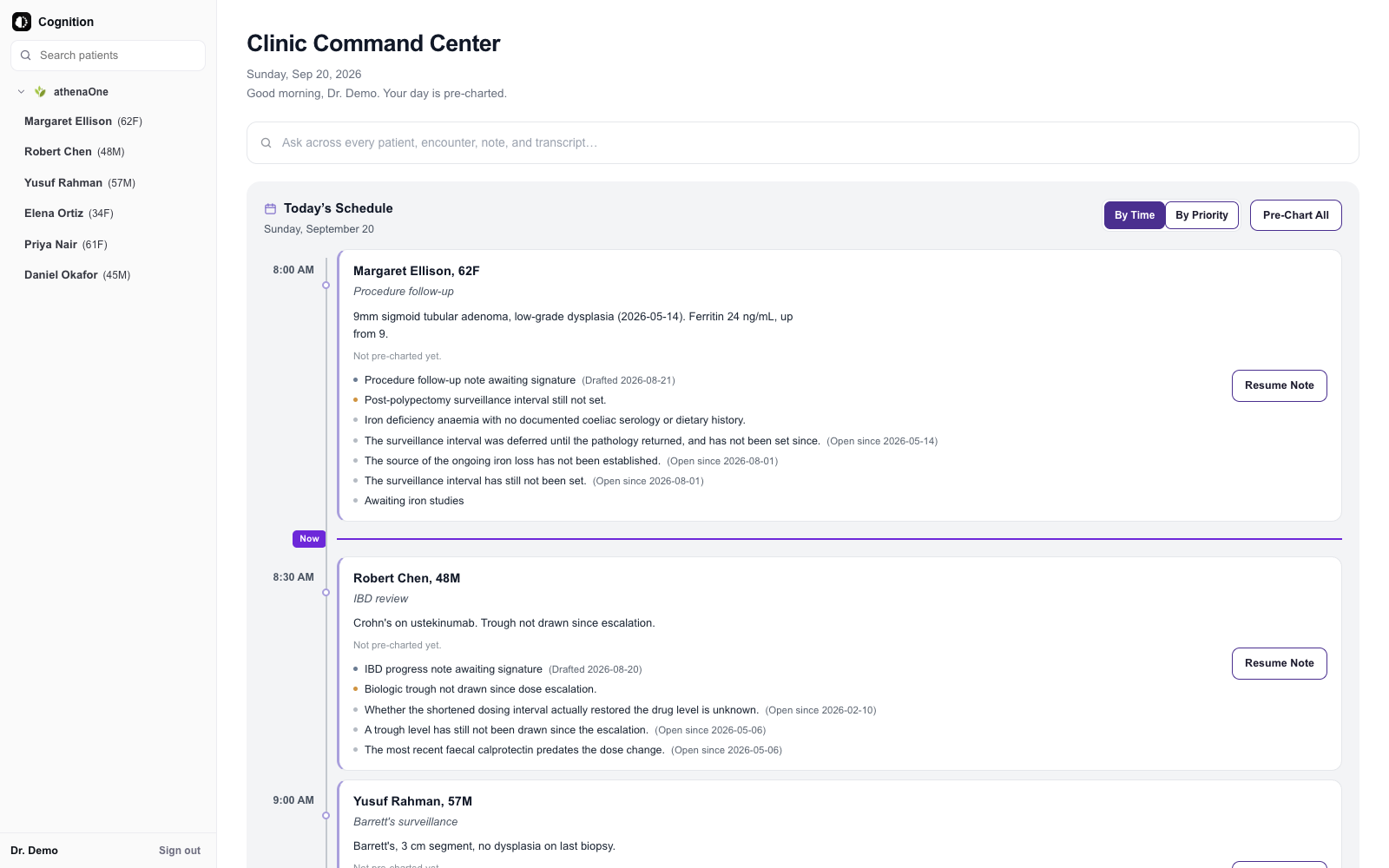
Synthetic clinical demonstrationCognition brings the required context, unresolved questions, evidence review, and authorized approval into the same interface where the clinical output is produced.
One control plane
Clinical risk is created by the interaction between models, prompts, tools, retrieved context, application logic, and human review. Cognition makes that full chain explicit and inspectable.
Set approved models, tools, data boundaries, and hard constraints before intelligence reaches a clinical workflow.
Turn each production prompt and workflow into a versioned clinical contract with required context and verification rules.
Route consequential outputs to the right clinician, preserve corrections, and make release decisions reconstructable.
From prompt to clinical receipt
The runtime does not merely log an answer. It preserves what the system needed to know, what evidence it used, where uncertainty remained, who approved the output, and what changed afterward.
Declare the patient state, policy, protocol, and workflow context required before the model answers.
Attach source material and distinguish retrieved fact from inference or missing information.
Send the output to the authorized care-team role with unresolved questions visible.
Preserve the version, reasoning, approval, corrections, and conditions for retesting.
Deliberate deployment
Establish the context contract, run synthetic and de-identified failure cases, measure review burden and critical omissions, then expand only when governance evidence supports it.
Designed for the full institution
Clinical informatics sees workflow behavior. Compliance sees approved boundaries and exceptions. Care teams see the context needed to review. Engineering sees versioned contracts and failure modes. Everyone works from the same reconstructable record.
A governed starting point
Bring one model, one application, and one care team. We will map the context, constraints, review path, failure cases, and evidence required before any broader deployment.
Book a working session